
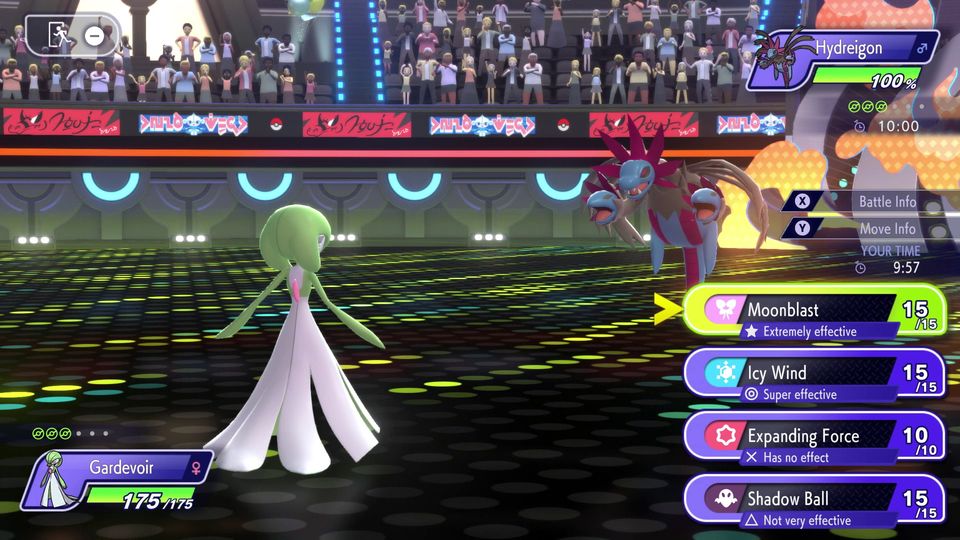
New to Pokemon Champions? It is the free-to-start competitive Pokemon battler, now live on mobile as well as Switch, and it is built entirely around PvP. There is no story and no wild catching, so the systems work differently from a mainline game. This Eden of Gaming guide walks through what the game is, how battles and training actually work, how you get Pokemon, how ranked is structured, and a sensible first week.
What Pokemon Champions is
Champions is The Pokemon Company's official competitive platform: the 2026 Ranked season, the Championship Series, and the road to the World Championships all run through it. It is out on Nintendo Switch and Switch 2 (April 8, 2026) and on iOS and Android (June 17, 2026), with full crossplay and cross-save through one Nintendo Account. There is no Terastallization here; the headline mechanic is the return of Mega Evolution.
Getting started
- Link a Nintendo Account. It unifies your Switch and mobile saves and enables crossplay, so set it up first.
- Play on anything. Switch, Switch 2, iOS and Android all share one matchmaking pool, so mobile and console battle each other directly.
- Finish the tutorial. It banks a large chunk of starting currency and places you at the bottom ranked tier ready to play.
- Connect Pokemon HOME if you have it. You can transfer eligible Pokemon in, which can replace most of your starter team.
The battle format
Training: Stat Points and Stat Alignment
This is the biggest difference from a mainline game, and the part most new players get wrong. You do not breed or grind EVs. Every Pokemon already has perfect IVs, and you customize stats with two systems spent in the Training menu using Victory Points (VP).
How stat customization works
The EV equivalent. You get 66 points per Pokemon, capped at 32 per stat, set on a slider. Roughly 1 point is about 8 EVs. Costs 5 VP per point, so about 330 VP to max a spread. Lowering points is free.
Fixed at perfect for every Pokemon. There is no breeding and nothing to hunt or fix.
The Nature replacement. It raises one stat by 10 percent and lowers another, and you can pick any alignment regardless of the Pokemon. Changing it costs about 500 VP. Serious is the neutral option.
You can select any of a Pokemon's legal abilities. Standard abilities are free to swap; the Hidden Ability costs about 500 VP.
One item per Pokemon, governed by the Item Clause. A few classic items are reportedly missing at launch, so check what is available.
Getting Pokemon: Recruit and HOME
- You recruit, you do not catch. The Roster Ranch shows ten Pokemon every 22 hours and you pick one. A permanent recruit costs about 2,500 VP or one Teammate Ticket, and a free seven-day trial lets you test a Pokemon you cannot yet train.
- After the tutorial you choose one of ten starter lineups, each a free full team of six. See the EOG.GG Reroll Guide for which lineup to pick and the best Pokemon to chase.
- Pokemon HOME transfers in eligible Pokemon from Scarlet and Violet, Pokemon GO and other HOME-linked games, but only species that exist in Champions can come over, and recruited Pokemon cannot be sent back out.
Ranked structure
- Two separate ladders, Singles and Doubles, with separate rewards, so playing both maximizes what you earn.
- Tiers climb Beginner, then Poke Ball, Great Ball, Ultra Ball, Master Ball, and Champion at the top. You start laddering at Poke Ball after the tutorial and cannot drop a whole tier once promoted.
- Seasons run about a month and pay out VP by tier at the end. The June 17 mobile launch came with a ranked reset and a regulation rollover, so everyone restarts the climb.
- Champions is the official path to organized play. The in-game ladder uses the same regulations as events, but Championship Points for Worlds 2026 come from sanctioned Championship Series events, not the in-game ladder.
Team building basics
- Think in pairs. Doubles is about how your two active Pokemon support each other, for example an Intimidate pivot next to a damage dealer.
- Pick one Mega as your win condition. Since only one Mega is allowed per battle, build around it rather than trying to fit several.
- Cover your weaknesses. Avoid stacking the same type weakness across the team, and bring at least one form of speed control.
- Use the in-game Battle Data. Champions shows popular moves, items and teammates, which is a built-in starting point before you touch third-party tools.
Essential doubles terms
Ability that lowers both opponents' Attack on switch-in. The format's most important support tool (Incineroar, Arcanine).
Priority move that flinches the target, but only on the user's first turn on the field. Free tempo.
Blocks all moves against the user for a turn. Success drops if used repeatedly. The single most common move in the format.
Spread moves hit both foes for 75 percent damage each; single-target moves hit one for full. A spread move that ends up hitting one target deals full damage.
Doubles your whole team's Speed for four turns. The main offensive speed control.
Inverts turn order so the slowest move first, for five turns. Lets slow bulky Pokemon outpace fast ones.
Follow Me and Rage Powder pull the opponents' single-target moves onto the user, shielding your partner. Rage Powder is ignored by Grass types and Safety Goggles.
Protects both your Pokemon from spread moves for a turn. Quick Guard does the same against priority.
Acting and switching out in the same turn for momentum: U-turn, Volt Switch, Flip Turn, and Incineroar's Parting Shot.
Your first week
- Day 1: finish the tutorial and pick a starter lineup that fits your format (Tyranitar for Doubles). You now have a free team of six.
- Day 2: in the Training menu, learn Stat Points and Stat Alignment, and browse Battle Data to see what the meta runs. Do not overspend VP yet.
- Day 3: drill the basics in Casual Doubles (no rank risk, still earns VP): targeting, spread moves, Protect, redirection, Intimidate, speed control.
- Day 4: use the free seven-day trial to test a meta Pokemon before you commit VP to it.
- Day 5: permanently recruit the one you liked most for about 2,500 VP and train it fully rather than spreading VP thin.
- Day 6: patch coverage gaps and lock a stable six. See the EOG.GG Tier List for current top picks.
- Day 7: enter Ranked Doubles from the Poke Ball tier and keep a Casual team for experiments. Clear daily and weekly missions every login, since VP is the bottleneck.